
Commas are back!
In Part One, we looked at how commas help us add extra information to the “heart” of a sentence. If you survived all that, congratulations! Now we can move on to some of the more everyday places where these tricky little punctuation marks appear.
Today, let’s look at commas in lists, commas between adjectives, and commas in letters and emails.
The good news? It’s much easier than the rules in Part One!
Let’s break this down and look at it from each angle.
Commas in lists
Let’s start with the easy one.
When you have a list of three or more things, use commas to separate the items.
- I bought bread, cheese, tomatoes and chocolate.
- For our trip, we need towels, sunscreen, sunglasses and snacks.
- My children spend most of their free time eating, sleeping, complaining and asking me for money.
Easy enough, right?
Normally, we don’t put a comma between the final two items because they are already joined by und or or.
But wait! What about the Oxford comma?
You may have seen sentences like this:
- I bought bread, cheese, tomatoes, and chocolate.
See that extra comma before und?
This is called the Oxford comma (or serial comma).
And here comes the slightly annoying part: it is optional.
Some style guides use it, while others don’t. It is especially common in American English, but that doesn’t mean every American uses it.
So these can both be correct:
- We invited Sarah, Mark and James.
- We invited Sarah, Mark, and James.
My advice? Pick a style and try to be consistent.
There is one situation, though, where that little Oxford comma can be extremely useful: when your sentence could otherwise be confusing.
Imagine you write:
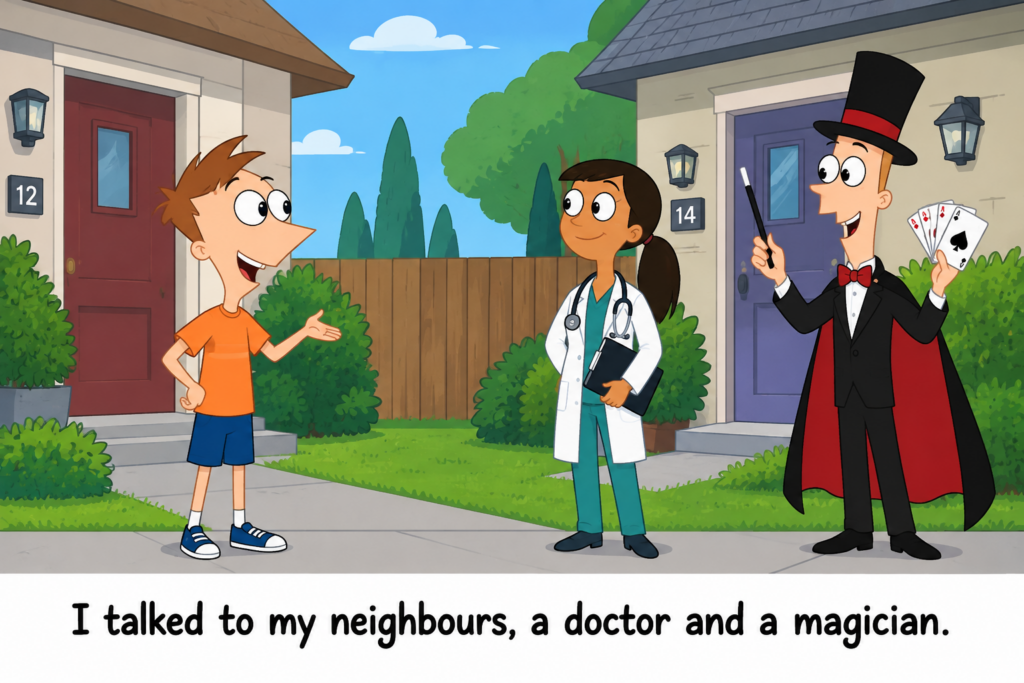
- At the party, I talked to my neighbours, a doctor and a magician.
Hmm. Are your neighbours a doctor and a magician? Or did you talk to your neighbours AND a doctor AND a magician?
Adding the final comma makes it clearer:
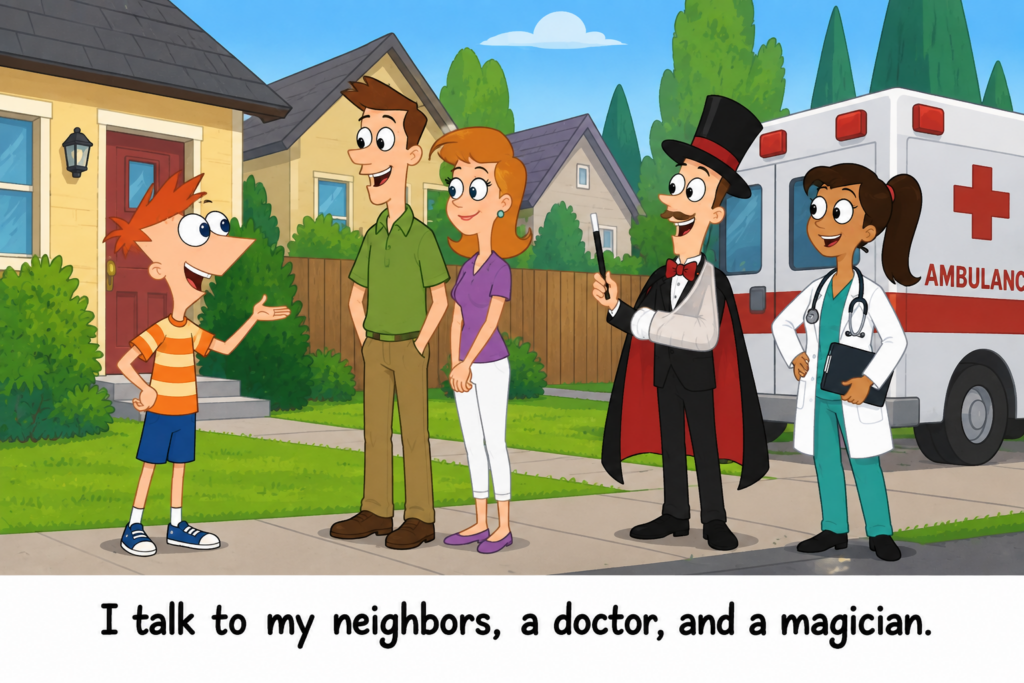
- At the party, I talked to my neighbours, a doctor, and a magician.
Now we know there were at least four people involved in this very interesting party.
So, even if you don’t normally use the Oxford comma, sometimes it can save your sentence!
Commas between adjectives
Okay, this one is a little trickier.
Sometimes we use two or more adjectives before a noun:
- She has a beautiful old house.
- He bought an expensive Italian car.
- We carried a large, heavy suitcase upstairs.
Wait a minute. Why does large, heavy suitcase have a comma, but beautiful old house doesn’t?
The answer depends on whether the adjectives are doing the same job.
When adjectives are equal, use a comma
If two adjectives describe the noun independently and are equally important, put a comma between them.
- It was a cold, rainy day.
- She is a friendly, intelligent woman.
- We had a long, difficult meeting.
- He gave me a strange, uncomfortable look.
There’s a handy little test you can use.
Try putting und between the adjectives:
a cold und rainy day
Sounds fine!
Now try reversing them:
a rainy, cold day
Still basically works.
That’s a good sign that you need a comma.
When adjectives work together, don’t use a comma
Now look at this:
- She is a beautiful old woman.
Would you normally say:
a beautiful und old woman?
Maybe, but it sounds strange.
And:
an old beautiful woman
Maybe, but it still feels wrong.
That’s because “old woman” works together as a unit, and beautiful describes that whole idea.
The same thing happens here:
- an expensive Italian restaurant
- a small wooden table
- a beautiful red dress
- a new electric car
We don’t normally put commas between these adjectives.
You definitely don’t need to memorise a giant chart showing which type of adjective comes before which other type. (Unless memorising giant grammar charts is your idea of a fun Friday night.)
Instead, remember the AND test.
If you can naturally put und between the adjectives, a comma probably belongs there.
A quiet, peaceful village.
A quiet und peaceful village. ✓
A beautiful Swiss village.
A beautiful und Swiss village. Hmm…no.
No comma!

Commas in letters and emails
Finally, let’s look at a place where I see comma confusion all the time: emails.
After the greeting
In an informal email or letter, you can put a comma after the person’s name:
Hi Peter,
Thanks for your message. I was wondering…
Or:
Dear Grandma,
Thanks for the birthday money. I definitely won’t spend all of it on pizza.
In more formal correspondence, conventions can vary between British and American English and between organisations. You may see:
Dear Mr Smith,
or simply:
Dear Mr Smith
(You may even see a colon in formal American business writing:
Dear Mr Smith:
But I think this is too far.)
So don’t panic if you see different versions. Email punctuation isn’t quite as universal as your English teacher may have made you believe.
The most important thing is to follow the style normally used in your organisation and be consistent.
After your closing
We also normally use a comma after a closing phrase – it depends on what we did at the beginning. If you use a comma after the greeting → use a comma after the closing.
Dear Thomas,
.…
Kind regards,
Mary
OR
Dear Norbert (no comma)
……
Best wishes (no comma)
Mary
Notice that you don’t need another comma after your name.
One more important email mistake
While we’re talking about emails, here’s something I often see:
Hello Peter,
thank you for your email.
If you’re starting a new sentence after the greeting, Thank needs a capital T.
The greeting isn’t the beginning of that sentence.
So write:
Hello Peter,
Thank you for your email.
This isn’t technically a comma rule, but since we’re here, why not?!
When you "say" someone's name in the sentence
Remember this rule from Part One?
If you “speak” directly to someone (including yourself) in your writing and use a name, separate the name with a comma.
- Peter, could you send me the document?
- Thanks for your help, Anna.
- Could you please check this, David, before you leave?
That last example looks strange to some learners, but the commas are correct. David is an interruption in the main sentence:
Could you please check this before you leave?
The sentence works perfectly without his name, so we use commas around it.
So, what do you need to remember?
If all these commas are starting to swim around in your head, focus on these three ideas:
Lists: Use commas to separate three or more items. The final comma before und is the optional Oxford comma—but use it when it makes your meaning clearer.
Adjectives: If the adjectives could naturally be joined with und, you probably need a comma: a long, difficult day. If they work together in a natural order, you usually don’t: a beautiful old house.
Emails and letters: You can choose: use a comma after the greeting AND after the closing, or use NO commas after the greeting and closing. But remember to use commas when you write the person’s name in a sentence to get their attention.
And most importantly, remember what we learned in Part One: commas aren’t just random little marks your English teacher throws into sentences to make your life difficult. They help your reader understand which words belong together, where one idea ends, and where the next one begins.
Once you start thinking about commas that way, they become much less mysterious.
Well, slightly less mysterious.
English is still English.
 Deutsch (Schweiz)
 English