
THE GRAMMAR OF ADVERBS AND ADJECTIVES
A lot of my students struggle with adjectives and adverbs. Do we say, “Rush hour traffic is normally” or, “Please do it careful”? No, no we don’t.
If this grammar is a mystery for you, you have come to the right place! Today, let’s just focus on adjectives and adverbs of manner (not adverbs about time).
First, look at the two comic strips:
The difference between adjectives and adverbs
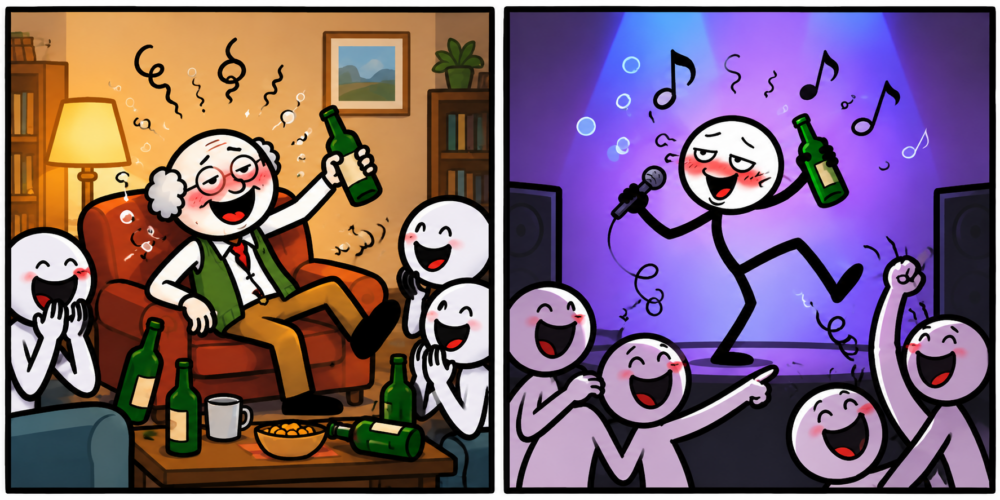
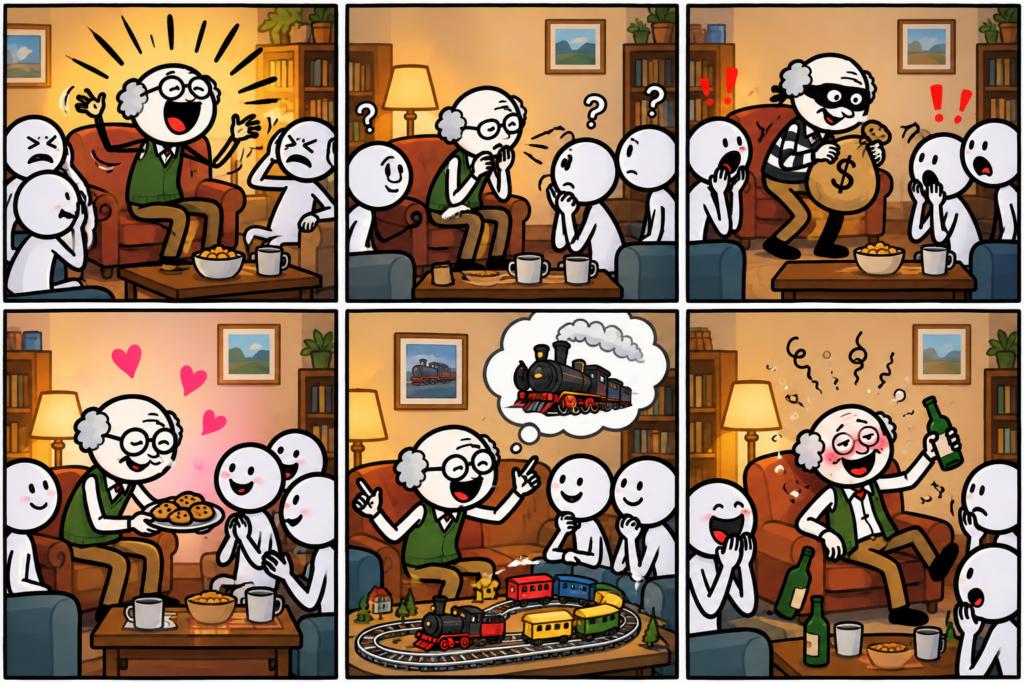
In the first comic, Grandpa is first loud, then quiet, then bad (you shouldn’t steal), but then he’s sweet, and then very passionate about trains, and, finally, he’s drunk.
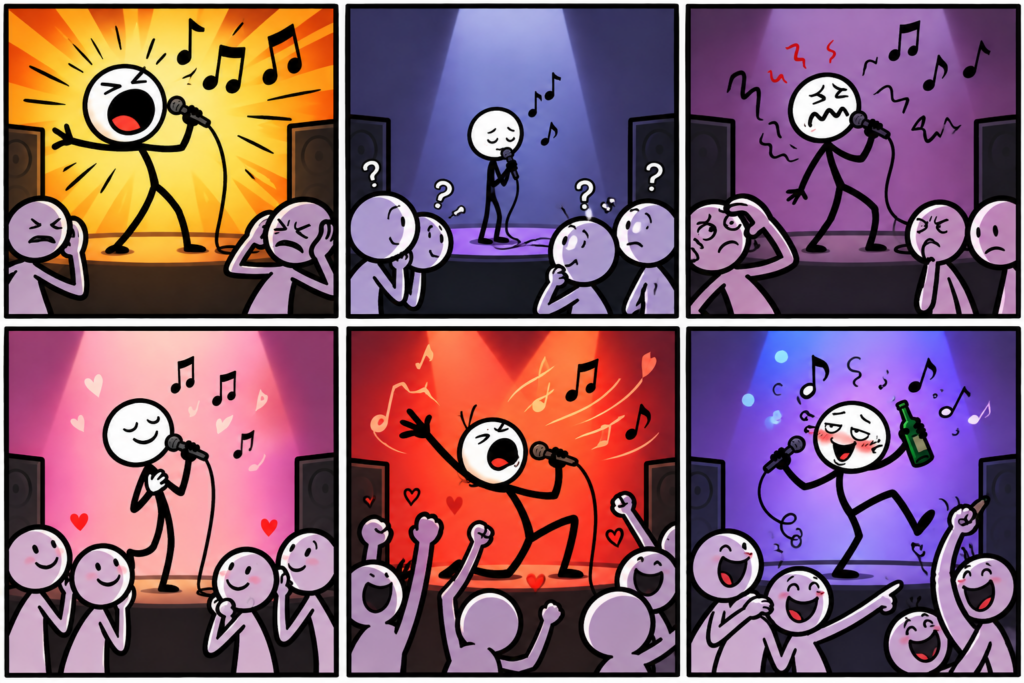
In the second comic, the karaoke singer sings very loudly, then too quietly, then unfortunately badly, then sweetly, then very passionately, and, finally, drunkenly.
What changed? The first group are adjectives. The second group are adverbs.
Adjectives describe people and things
An adjective gives us more information about a noun — a person, place, thing or idea.
Look at Grandpa:
Grandpa is loud.
Here, loud describes Grandpa. It tells us what he is like.
The same pattern works throughout the comic:
- Grandpa is loud.
- Grandpa is quiet.
- Grandpa is bad.
- Grandpa is sweet.
- Grandpa is passionate.
- Grandpa is drunk.
Notice that we often put an adjective after the verb be:
subject + be + adjective
So we can say She is quiet, The children are loud or My neighbours are drunk.
We also use adjectives after verbs that are (kind of) synonyms for “be”: seem, appear or appear to be, look (when it means the same as seem), taste. All of these verbs are kind of like an equal sign in math. Grandpa = loud. So:
He looks crazy. She seems happy. This tastes good.
Adjectives can also come directly before nouns: a loud neighbour, a quiet room, a bad person, a sweet grandpa, a passionate train enthusiast.
Adverbs describe how we do things
Now look at our karaoke singer. This time, we aren’t really describing the man. We’re describing how he sings.
He sings loudly.
Loudly tells us more about the verb sings. It answers the question:
How does he sing?
He sings loudly.
The same thing happens in the other panels:
|
Adjective |
Adverb |
Example |
|
loud |
loudly |
He sings loudly. |
|
quiet |
quietly |
He sings quietly. |
|
bad |
badly |
He sings badly. |
|
sweet |
sweetly |
He sings sweetly. |
|
passionate |
passionately |
He sings passionately. |
|
drunk |
drunkenly |
He sings drunkenly.* |
*sometimes we change the adjective more than just adding an -ly. Read more about that below.
This gives us another useful pattern:
subject + verb + adverb (when the verb doesn’t mean =)
She speaks quietly.
He drives badly.
They kissed passionately.
Compare Grandpa with the karaoke singer
This is the key difference:
Grandpa is loud.
The man sings loudly.
In the first sentence, loud describes the person: Grandpa.
In the second, loudly describes the action: singing.
Try another pair:
Grandpa is passionate.
The man sings passionately.
Grandpa himself is passionate — especially when trains are involved! The karaoke singer performs his song in a passionate way.
And another:
Grandpa is sweet.
The man sings sweetly.
Sweet tells us what Grandpa is like. Sweetly tells us what action (the singing) is like.
A useful question to ask yourself is:
Am I describing a person or thing, or am I describing an action?
If you’re describing a person or thing, you need an adjective.
If you’re describing how someone does something, you need an adverb.
Why do so many adverbs end in -ly?
In English, we can make many adverbs by adding -ly to an adjective:
loud → loudly
quiet → quietly
sweet → sweetly
passionate → passionately
But English is English, so of course there are a few complications.
Bad becomes badly: bad + ly → badly. But other words require a spelling change: happy → happily, drunk → drunkenly.
And not every adverb ends in -ly. Compare:
He is a fast runner.
He runs fast.
Here, fast is the same as both an adjective and an adverb.
There’s also a famous irregular pair:
She is a good singer.
She sings well.
It’s not correct to say, “She sings good” in standard English when we mean that she sings skillfully.
Your turn
Imagine that Grandpa and the karaoke singer meet. Choose the correct form in each sentence:
- Grandpa speaks loud / loudly.
- Grandpa is very loud / loudly.
- The man sings bad / badly.
- His singing is bad / badly.
- Grandpa talks passionate / passionately about trains.
- Grandpa is passionate / passionately about trains.
- The singer performs the love song sweet / sweetly.
- The singer’s voice is sweet / sweetly.
Answers: 1 loudly, 2 loud, 3 badly, 4 bad, 5 passionately, 6 passionate, 7 sweetly, 8 sweet.
The simplest rule to remember is this:
Adjectives describe people and things. Adverbs describe actions.
So Grandpa can be loud — so if he starts doing karaoke too, he’ll probably sing loudly.
Intermediate to Advanced (A2 students can stop here)
IRREGULAR ADVERBS
So…. What is up with drunk and drunkenly?
Why don’t we just add an -ly and say “drunkly”?
Grandpa was drunk, so he walked drunkenly across the room.
I think the answer is that the adjective USED to be “drunken”, but I’m not going to look that up.
Unfortunately, there are many adverbs that are irregular in different ways. Here are more adverbs that are special:
1. Adverbs ending in -ly with extra spelling changes
These aren’t really irregular grammatically. They follow normal spelling rules when -ly is added.
For example:
happy → happily (not happyly)
gentle → gently (not gentlely)
Here’s a handy list of the most important ones:
|
Adjective |
Adverb |
|
happy |
happily |
|
easy |
easily |
|
angry |
angrily |
|
gentle |
gently |
|
simple |
simply |
|
terrible |
terribly |
|
possible |
possibly |
|
true |
truly |
|
whole |
wholly |
|
drunk |
drunkenly |
|
crazy |
crazily |
2. Truly irregular adjective → adverb forms
The MOST important one is:
|
Adjective |
Adverb |
Example |
|
good |
well |
She’s a good singer. → She sings well. Your English is good. |
Good → well is the major irregular adjective/adverb pair learners need to remember.
Your English is good! You speak English very well. 🙂
3. Adjectives and adverbs with the SAME form
These words can be adjectives or adverbs without changing their spelling.
|
Adjective |
Adverb |
Examples |
|
fast |
fast |
a fast car → it drives fast |
|
hard |
hard |
hard work → we work hard |
|
late |
late |
a late arrival → he arrived late |
|
early |
early |
an early train → I arrived early |
|
straight |
straight |
a straight line → go straight |
|
long |
long |
a long journey → I didn’t stay long |
|
high |
high |
a high mountain → fly high |
|
low |
low |
a low price → don’t fly too low |
|
near |
near |
the near side → come near |
|
far |
far |
the far end → travel far |
|
right |
right |
the right answer → guess right |
|
wrong |
wrong |
the wrong answer → guess wrong |
|
wide |
wide |
a wide opening → open wide |
|
close |
close |
a close friend → stay close |
|
free |
free |
a free ticket → travel free |
|
deep |
deep |
a deep hole → dig deep |
These are useful exceptions to the beginner rule that says, “Add -ly to make an adverb.” I feel like most of these are direction adverbs, so maybe that will help.
4. Evil adverbs: adverbs with -ly but they’re false friends with the adjectives
This is probably the most interesting group for more advanced learners. In these cases, both adverbs exist, but they mean different things. A particularly important example for learners is:
He works hard. = He works a lot / with great effort.
He hardly works. = He does almost no work.
Adding -ly COMPLETELY changes the meaning.
Watch out:
hard → hardly
He works hard. = He works with a lot of effort.
He hardly works. = He almost doesn’t work.
late → lately
She arrived late. = after the expected time
I haven’t seen her lately. = recently
near → nearly
Come near. = come closer
It’s nearly finished. = almost
high → highly
The bird flew high. = at a great height
She’s highly qualified. = very/extremely
wide → widely
Open your mouth wide. = to its full width
The book is widely known. = by many people
close → closely
Stay close. = nearby
Look closely. = carefully
free → freely
Children travel free. = without paying
You can speak freely. = without restriction
deep → deeply
Dig deep. = to a great depth
I’m deeply worried. = intensely
5. Evil adjectives: adjectives that end in -ly, so you can’t use them as adverbs!
And one final warning: some English adjectives already end in -ly. Words such as friendly, lovely, lonely, lively, silly, ugly, and elderly may look like adverbs because they end in -ly, but they are actually adjectives.
Because of this, we usually cannot simply add another -ly to make an adverb. Instead, English often uses “in a … way/manner”.
|
Adjective |
Adverb / adverbial expression |
Example |
|
friendly |
in a friendly way |
She greeted us in a friendly way. |
|
lovely |
in a lovely way |
She decorated the room in a lovely way. |
|
lively |
in a lively way |
They discussed it in a lively way. |
|
lonely |
in a lonely way |
He wandered around in a lonely way. |
|
silly |
in a silly way |
He behaved in a silly way. |
|
ugly |
in an ugly way |
The argument ended in an ugly way. |
|
cowardly |
in a cowardly way |
He behaved in a cowardly way. |
|
scholarly |
in a scholarly way |
She approached the subject in a scholarly way. |
|
elderly |
— |
This normally describes a person rather than a manner of doing something. |
|
deadly |
deadly / in a deadly way |
The snake can strike deadly is uncommon; with deadly force is more natural. |
The important rule
You can’t assume that a word ending in -ly is an adverb.
In this sentence:
My friendly neighbour smiled at us.
friendly is an adjective because it describes “neighbour.” My neighbour = friendly.
If we want to describe how the neighbour smiled (maybe because actually my neighbor is evil), we can’t say:
❌ My neighbour smiled friendly.
❌ My neighbour smiled friendlily.
Instead:
✓ My neighbour smiled in a friendly way.
So, what do you need to remember?
So a useful learner-friendly rule is:
Adjectives with -ly don’t have a normal -ly adverb to describe how the action was done. So, use “in a/an + adjective + way” instead.
In fact (here is my secret tip), you can basically never go wrong with this strategy!!!
He ate in a messy way. He drove in a crazy way. He cleaned in an efficient way.
These are all correct (or, at least, not NOT correct), even though the more common sentences are:
He ate messily. He drove crazily. He cleaned efficiently.
 English
 Deutsch (Schweiz)