

Commas can be tricky little things! They pop up in unexpected places, but then they’re missing in the places you’d put them if you were writing in your own language! Don’t worry, though, even native English speakers have difficulty with commas sometimes because…
Commas are used in many different ways
- I bought popcorn, ice cream, nuts and seeds, and cake at the store. (commas in a list)
- In the desert sky at night, you can see shooting stars. (after an introductory phrase)
- My best friend, Andie, lives by the river. (around extra information )
Today, let’s just focus on commas for adding clauses, phrases and interjections to your main sentence.
Here’s the first step: let’s look at the “heart” of a sentence: SUBJECT + VERB + DIRECT OBJECT (if needed). Side note: Adverbs of frequency and adverbs of action fit inside this word order no problem, because they are best friends with the verb. But if you want to put information before the main sentence or “break the heart of the sentence” (interrupt the word order) with extra information, you need to use commas.
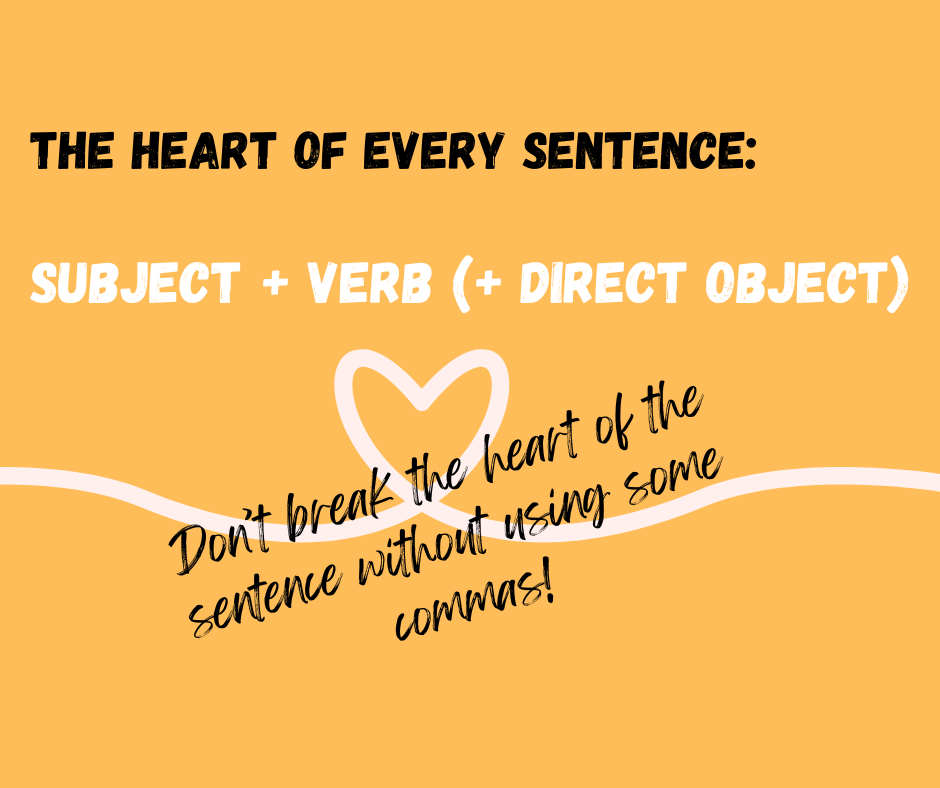
Let’s break this down and look at it from each angle.
Commas before the subject in the main clause
Sentences can start with clauses which have a subject and verb but aren’t actually full sentences on their own. We call these dependent clauses.
For example: As soon as I finish my homework, I am going on a run.
Here, “I am going on a run” is a full sentence on its own, so it’s called the independent clause. The independent clause is the real focus of the sentence. The first part, “As soon as I finish my homework,” isn’t a full sentence alone because it start with words like “if”, “because”, whether”, “before” and many more. (To learn about all the useful words, called subordinating conjunctions, click here.)
When starting with a dependent clause, we end it with a comma before the subject in the main clause. This tells the reader, “Hey! This next part is the important part!”
- If it rains tomorrow, I won’t work in my garden.
- After Ryan finishes his book, he’ll watch some videos.
If you decide to put the dependent clause after the independent clause, you don’t use a comma because, hey, the reader has already seen the “heart” of the sentence. (There are exceptions for “although” and “even though”, which you can read about here.)
- I will cancel the picnic if it rains in the morning.
- The builders cleaned the room after they finished their work.
You can also start the sentence with a phrase without a verb. Here, you add a comma before the subject in the main sentence.
- Excited to see her friends, the woman left work early.
- On Saturday morning before sunrise, Lindsay left her house with a large, heavy garbage bag.
Again, if you put a phrase at the end of the sentence, you don’t use a comma.
- Children should get enough sleep for a healthy life.
- I do yoga every Saturday before breakfast because I am awesome.
Commas with interjections & opinion adverbs
Interjections (“of course”, “you know”, “honestly”, etc.) and introductory adverbs (“naturally”, “fortunately”, etc.) are often at the start of the sentence or can come at the end, and these always need a comma. Sometimes you can even “break the heart” of the main clause with these words, and then you need two commas! Think about it like this: unlike the clauses above, which don’t need a comma when they come after the heart of the sentence, these words are more like outside interruptions that the sentence needs protection from.
- Lately, I’ve been eating a lot of ice cream. (If you put “lately” at the end of the sentence, a comma is optional.)
- You know, ice cream contains calcium. OR Ice cream contains calcium, you know.
- Honestly, ice cream is the best. OR Ice cream, honestly, is the best. OR Ice cream is the best, to be honest.
Commas with the reader's name, filler words, sentence tags, and natural pauses
With the same logic, commas are necessary around, before, or after these words or phrases. One helpful tool is to decide whether the sentence would be complete without that word or phrase.
- Well, I don’t have time for that.
- Yeah, I mean, we can go if you want.
- I hope that you, um, understand.
- Peter, please come here.
- Actually, you know, we prefer organic food.
- You live in the city, don’t you?
Commas around extra information
If the information you want to add after the noun is necessary in order for the reader to understand the sentence, this is called a defining clause and there are no commas.
- The girl who brought us the tea stole my phone.
- The car that hit me crashed into the river.
In this sentence, the reader needs the info in order to know which girl I am talking about, so the clause (“who brought us the tea”) is essential for understanding the sentence. This means that the subject of the sentence is “The girl who brought us the tea”, “stole” is the verb, and “my phone” is the direct object.
Now, if you add information after a noun, but this info is NOT needed for us to understand the sentence, then that info is nonessential. This is called a non-defining relative clause, and it requires commas around it so that you don’t “break the heart” of the sentence. (This grammar topic is a biggie and can change your meaning, so if you haven’t learned about it yet, maybe it is time. You can learn about it here.)
- Roger, who normally wears a baseball cap, is a foreign spy.
- Caroline, whose desk is next to mine, chews gum very loudly.
In these sentences, it is clear to the reader who Roger and Caroline are, so the clause after the subject is non-defining and needs commas to separate it from the “heart of the sentence”. One important note: with a non-defining relative clause, after the comma you need to use the words: WHO, WHOM, WHOSE, WHERE, or WHEN. You should never use the word THAT in non-defining clauses. In fact, you should never put a comma before the word THAT. Keep reading to find out more about this common mistake.

NO Commas before "that"??
This is correct. While in German, a comma is 100% necessary before clauses that start with “that”, in English it is basically forbidden. This is true for non-defining clauses, like above, and also for verbs that need a clause as its direct object.
- I hope that you have a nice life.
- He wished that he had met her sooner.
- She believed that she was doing the right thing.
- I understand that all payments are final.
This is one of the most common mistakes from my German-speaking students, and if you learn one thing from this article, I hope that it is this final rule.
In the upcoming PART TWO of my posts about commas, I will review the rules for commas when combining two sentences into one compound sentence, making lists and series, and using commas when writing dates, addresses, and more!
 Deutsch (Schweiz)
 English